
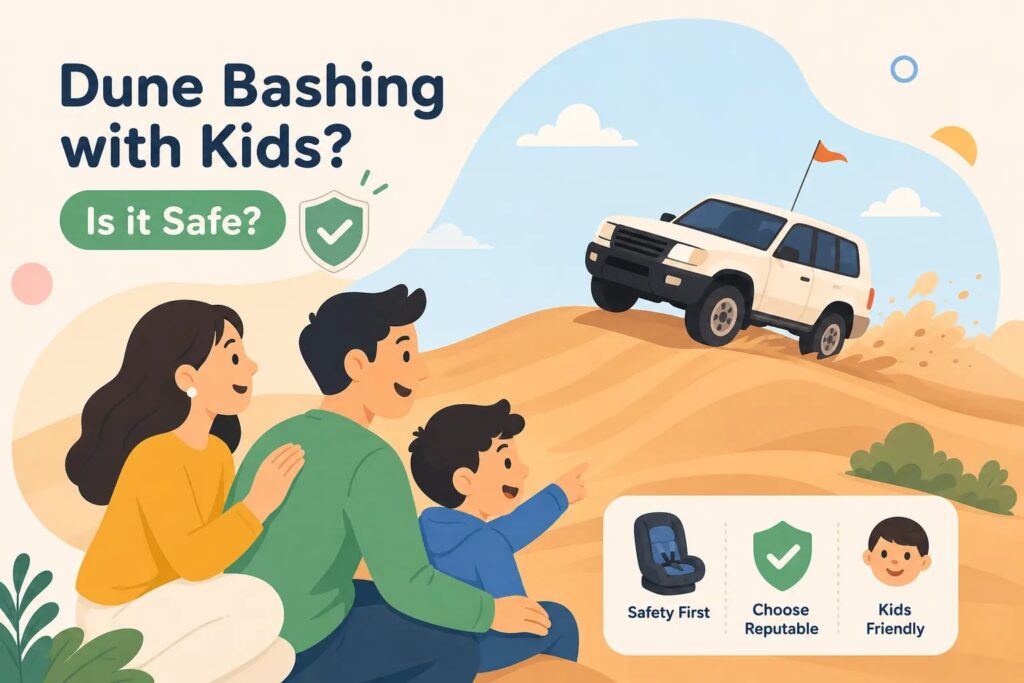
Is dune bashing safe for kids in Dubai? Suitability depends on the child and the booked activity; no operator can promise a risk-free ride. At Desert Leap Safari, children under five must not take part in dune bashing. For children aged five and above, confirm eligibility and suitable restraints before booking. Read our child ages and family safari guide, check the Family Desert Safari options and use our booking checklist. Ask about a confirmed camp transfer without dune bashing for younger children.
You are not being overprotective for asking this question. Dune bashing involves real g-forces acting on small bodies, and the difference between a thrilling family memory and a frightening one comes down entirely to the choices made before you get in the vehicle. This guide covers age limits, the real risks, what equipment to expect, and the questions that separate a responsible operator from one you should walk away from.
Key takeaways for parents
- Under-five restriction: Children under five must not join dune bashing with Desert Leap Safari, including reduced-intensity dune routes.
- Age 5 and above: Children aged 5 to 6 and older are generally accepted for 4×4 dune bashing; dune buggy passengers are typically accepted from age 6 with an adult present.
- Individual seatbelts are non-negotiable: Every passenger needs their own functioning restraint. A child sharing a belt or sitting on a lap is not a safe substitute.
- Ask before you book: Confirm RTA authorization, vehicle inspection status, and the operator’s written child restraint policy before paying anything.
- Ask about a camp transfer: For children under five, request a route without dune bashing and confirm availability, suitable restraints and activity eligibility before payment.
- Camp activities stand alone: Camel rides, henna, falcon photography, cultural performances, and a BBQ dinner give young children a full desert evening without any dune driving required.
Is dune bashing safe for kids in Dubai? What the age guidelines say
Desert Leap Safari does not allow children under five to join dune bashing. Booking a private vehicle or fitting a child seat does not remove this restriction. If a younger child is travelling, ask the team to confirm a suitable transfer without dune bashing before you reserve. Other operators may have different policies, so check the exact activity and vehicle arrangements in writing.
For most families, the practical soft minimum is 5 to 6 years for 4×4 dune bashing. Dune buggy passengers are generally accepted from age 6 when accompanied by an adult, while dune buggy driving is a separate category: many operators require the driver to be at least 16, though some allow 15, so confirm the threshold when you book. Dubai’s RTA and DET govern operator licensing, vehicle approval, and driver qualification, but neither body publishes a single universal minimum passenger age for dune bashing activities.
| Activity | Typical minimum age | Key restraint requirement |
|---|---|---|
| Dune bashing in a 4×4 | 5 to 6 years (under 3 not recommended) | Individual seatbelt; child seat on request for younger children, confirm availability and correct installation with the operator |
| Dune buggy, passenger | 6 years, with adult present | Buggy seatbelt; confirm roll cage and restraint suitability |
| Dune buggy, driving | 15 to 16 years (varies by operator) | Seatbelt and helmet; safety briefing mandatory |
| Camp-only (no dune bashing) | All ages | Standard vehicle transport; confirm child seat availability with the operator if needed for under-3s |
Age is only one eligibility check. Tell the operator about your child’s needs before booking and seek advice from your child’s clinician if a health condition could affect participation. For a child who cannot join dune bashing, request a confirmed transfer without dune bashing; do not assume a gentler route removes the restriction.
What are the real risks parents should understand?
The physics of dune bashing are what make it exciting for adults and what make it risky for small children. Sharp drops, lateral swerves, and sudden climbs create forces that adult bodies handle more easily than children’s. The specific risks include head and neck impact injuries from striking the seat or roof, concussions, spinal stress from repeated jolts, and fractures. Toddlers are especially vulnerable because they cannot brace themselves during sudden movements and cannot reliably describe pain afterward.
Know what to look for during and after the ride. Head injury warning signs include persistent or worsening headache, dizziness, confusion, unusual sleepiness, vision problems, repeated vomiting, slurred speech, unequal pupils, or any loss of consciousness. Neck and spine concerns include back or neck pain, weakness, numbness, tingling, or inability to move a limb. These symptoms require immediate medical attention. If a spinal injury is possible, do not move the child while waiting for emergency services.
Motion sickness and heat exposure are more common and more manageable. Nausea, pale skin, and sweating during the ride are signs of motion sickness that can be reduced by sitting in the front seat when possible, staying hydrated throughout the day, and timing your safari during the cooler months between November and April. Dehydration in the desert heat shows up in young children as unusual tiredness, dry mouth, or irritability. Bring water and dress children in light layers. Before booking, confirm that the camp has adequate shade available, it matters more than it sounds on a warm afternoon.
What safety equipment and driver qualifications should you expect?
Dubai Tourism’s Desert Tour and Camp Regulations establish minimum standards for licensed operators, covering health and safety, mandatory guest safety briefings, vehicle inspections, approved safety equipment, certified drivers, and child car seat requirements. Separately, tourist transport rules require operators to hold RTA authorization, use vehicles meeting UAE technical specifications and RTA inspection standards, and employ RTA-authorized drivers. These are baseline requirements, not optional extras, and you have every right to ask an operator to confirm compliance before paying.
The vehicle itself needs functioning seatbelts for every individual passenger. Lap-riding, where a child sits on an adult sharing a single belt, is not an acceptable safety arrangement, and no responsible operator should allow it. If your child needs a child seat or booster, confirm that the seat is available, appropriate for your child’s age and weight, and correctly installed before the vehicle moves. For buggy activities, the vehicle should include a roll cage or certified protective structure alongside proper restraints. If the operator cannot confirm these details clearly, choose another provider.
Driver qualification matters as much as the vehicle itself. Dubai requires dune bashing drivers to hold a valid UAE driving license for the relevant vehicle class and an RTA Desert Driving Permit, obtained through required theory and practical desert-driving training. This is a separate qualification from standard road driving and reflects the specific skills needed to read terrain, control speed on loose sand, and adjust the experience based on who is in the vehicle. That adjustment is what transforms dune bashing from a rough ride into a controlled family experience.
What should you ask any operator before you book?
Five questions will tell you most of what you need to know:
- What is the minimum age for dune bashing on the specific package you are booking, and does that change by vehicle type?
- Do they provide a child seat or booster for your child’s age and weight, and who installs it?
- Is the vehicle RTA-authorized and when was it last inspected?
- Can the driver adjust the intensity of the dune bashing based on the children in the vehicle?
- Do they offer a camp-only option or a reduced-speed route for families with very young children?
Pay close attention to how these questions are answered. An operator who responds with specific details rather than vague reassurances is demonstrating exactly the kind of competence you want behind the wheel. An operator who cannot answer clearly, who suggests a child can share a seatbelt, or who becomes evasive about vehicle inspection history is giving you a signal worth acting on, find another operator. Confidence and clarity on safety questions is itself a quality marker for any desert safari operator worth your money.
How Desert Leap Safari approaches families on the dunes
Desert Leap Safari runs red dune bashing adventures in 4×4 vehicles with experienced off-road drivers, and the entire experience is bundled into a single booking: dune bashing, camel rides, a BBQ dinner under the stars, and live cultural entertainment at the camp, with free hotel pickup and drop-off included across Dubai. For families, that bundling matters. You are not coordinating between multiple vendors or figuring out transport separately on the day; everything is organized around one clear booking.
Our online booking process takes 60 seconds. We offer several packages to match different budgets and group sizes, so families are not locked into a one-size option. Free hotel pickup removes one of the most consistent logistical headaches for families traveling with children in Dubai, and an evening that moves from the city to the dunes to the camp to dinner is handled through one operator, start to finish.
What are the safer alternatives when dune bashing isn’t right for your child?
Reduced-intensity dune driving may be requested for eligible guests, subject to the driver and route conditions. It remains dune bashing and is not an option for children under five on Desert Leap Safari tours. For younger children, ask for a confirmed camp transfer without dune bashing. Confirm the transport route, child restraints and available camp activities before paying.
Skipping or softening the dune bashing does not diminish the desert experience for young children. In practice, the camp is where children’s memories are made. Camel rides, henna painting, falcon photography, Arabic costume photos, beginner sandboarding on small slopes, and live cultural performances including tanoura dancing fill an evening quickly. Add a BBQ dinner with a selection of grilled foods and a Bedouin-style camp atmosphere, and the sunset view alone is worth the drive out. A well-run desert camp evening is a complete experience with or without aggressive dune driving.
Family Packing Checklist for a Safer Dune Drive
A little preparation makes a big difference to how children feel in the 4×4. Most motion sickness and grumpy moments on a desert safari come from heat, hunger or loose items rolling around the car, and all three are easy to avoid.
- A light snack and water for each child, eaten at least 30 minutes before the dune drive rather than during it.
- Motion sickness bands or medicine recommended by your own doctor or pharmacist, if your child usually gets car sick.
- Closed shoes or sturdy sandals, plus socks, because the sand can be very hot in the afternoon.
- Sunglasses, a sun hat and child-safe sunscreen for the photo stops and the camel ride.
- A light jacket or hoodie for winter evenings, when the desert cools down quickly after sunset.
- A small bag or zip pouch for phones, tablets and toys so nothing flies around on the dunes.
- Wet wipes and a spare set of clothes for the ride home after sandboarding and sand play.
- Your own booster seat if your child is small and you prefer a seat you already trust.
Pack these items the night before and share any concerns with the team when you book. When parents arrive prepared and the driver knows there are children in the car, dune bashing in Dubai becomes a calm, fun family memory instead of a stressful ride.
One last tip: book the earliest evening pickup or a morning safari when travelling with young children. The air is cooler, the dunes are quieter and kids are usually more relaxed and rested. You also get back to your hotel in good time for dinner and bed, which keeps the next day of your Dubai holiday on track for the whole family.
More Family Safari Guides
Planning a full family day in the desert? Read our guide to family safari rules, ages and tips, check the desert safari Dubai timings to pick a slot that fits nap times, and see what is included in a Dubai desert safari package before you compare prices. If you are expecting, our article on whether a desert safari is safe during pregnancy explains the softer options. For calm, low-energy fun, the Dubai camel ride tips guide is perfect for younger children, and our best time to visit Dubai desert guide helps you avoid the hottest months with little ones.
Age-by-Age Guide: What Kids Can Do on a Dubai Desert Safari
- Babies under 2: Skip dune bashing completely. Ask for a no-bashing transfer straight to camp, where babies can enjoy the sunset, music and open space safely in a parent’s arms.
- Toddlers aged 2 to 4: A very gentle, short drive on low dunes may be possible with a proper child seat, but most parents choose the camp-only option. Camel photos and sand play are the highlights at this age.
- Kids aged 5 to 8: A soft dune drive is usually fine with a booster seat, a seatbelt that fits correctly and a driver who knows a child is on board. Short camel rides and sandboarding on small slopes work well.
- Kids aged 9 to 12: Most children this age enjoy a standard family dune drive. Keep breaks between dunes, sit them behind the driver and let them try sandboarding with supervision.
- Teenagers 13 to 17: Teens can usually join regular dune bashing. Quad bikes and dune buggies have their own age and height limits, so check those rules separately before booking.
Every child is different, so use these ages as a starting point rather than a strict rule. If your child gets car sick, has a medical condition or simply feels nervous, tell the driver before you set off. A good family operator will slow down, stop for breaks or skip the steeper dunes without any fuss.
Is dune bashing safe for kids in Dubai? Plan your trip with confidence
Dune bashing in Dubai can be safe for children when the right conditions are in place: a child aged 5 or above, a licensed operator using inspected vehicles, an individual seatbelt or appropriate child restraint for every passenger, an experienced driver, and a parent who has asked the right questions before getting in the car. That is a specific checklist, and confirming each item at the booking stage takes only a few minutes.
Trust your instincts as a parent. If an operator deflects on safety questions, that is a signal worth acting on. If your child is nervous or unwell on the day, the camp experience alone is a complete evening.
The desert at sunset does not require a dramatic dune drop to be magical, a child watching a tanoura dancer perform against a backdrop of red dunes turning gold in the last light will carry that memory home regardless of whether they ever made it up a dune. Reach out to our team with questions about your group’s ages and needs before you book; we would rather answer them upfront than leave anything to chance on the day.
Families who want to experience the dunes with confidence are welcome to start with Desert Leap Safari’s 60-second booking process. Free hotel pickup, an experienced team, and a fully bundled Arabian night are ready when your family is.
