
You open two browser tabs. Both say “evening desert safari Dubai.” The prices look almost identical. But one package has a BBQ dinner listed, and the other just says “meals available.” One mentions hotel pickup; the other buries the words “pickup included from select areas” in fine print. By the time you’ve read three more listings, you’ve lost track of what’s actually standard and what’s a paid extra.
If you’re trying to figure out what is included in a Dubai desert safari package, you’re not alone, this is the exact confusion most first-time visitors run into. The core experience sounds simple, but the details are where packages diverge significantly. This guide breaks down every element you’ll find across standard, VIP, and private desert safari packages in Dubai, so you know exactly what you’re getting before you book. Operators like Desert Leap Safari bundle everything into one clear package, bookable in 60 seconds, which is the kind of simplicity this article is designed to help you find and recognize.
What is included in a Dubai desert safari package, core activities
Dune bashing: the anchor experience
Dune bashing is the centerpiece of every Dubai desert safari, regardless of package tier. An experienced driver takes you through 45 to 60 minutes of controlled descents and climbs across red sand dunes in a 4×4 vehicle, typically a Toyota Land Cruiser. The vehicles are fitted with roll bars and safety equipment, and the drivers are trained specifically for desert terrain, not just general off-road driving.
Most reputable operators head to the Lahbab area, also known as the Red Dunes, located roughly 45 minutes southeast of Dubai. This terrain is different from the flat, golden sand most people picture. The Lahbab dunes are steeper, higher, and a distinctive deep red color due to the iron oxide content in the sand. That combination of height, color, and gradient is what makes the Dubai dune bashing experience visually striking and physically more intense than other desert destinations.
One note on health restrictions: pregnant women and anyone with back, neck, or heart conditions should skip the dune bashing portion. Most operators set a minimum age of 6 years for standard dune bashing. Children under 3 are not suitable for the activity at all, and the 3 to 5 age group is a gray area that depends on the operator and whether a private vehicle with a child seat is arranged.
Camel rides, sandboarding, and what else is waiting at camp
After dune bashing, the convoy moves to the desert camp, and this is where the rest of the standard inclusions kick in. Camel rides are included in virtually all evening safari packages; they’re typically positioned near the camp entrance and run for a short circuit. Sandboarding, where you strap a board to your feet and slide down a dune face, is included in most standard evening packages and is available throughout the early camp period before entertainment begins.
Falconry photo opportunities are common at evening camps, but the inclusion structure varies. Some operators bundle a complimentary photo with a falcon into the package; others offer it as an experience you pay for separately at camp. If a falcon photo matters to you, confirm this before you arrive rather than assuming it’s free.
Cultural performances: what happens after the sun goes down
Once the sun drops and dinner wraps up, the camp shifts into entertainment mode. A standard evening lineup typically includes a Tanoura dance (a spinning folk performance rooted in Sufi tradition), a belly dance, and a fire show as the finale. The setting is open-air with low lighting, carpeted seating areas, and a relaxed atmosphere that’s a noticeable shift from the adrenaline of the earlier dune bashing session.
Henna painting is available at most evening camps, but it functions more like a tipped service than a formal inclusion. Budget around AED 20 to 50 depending on the design. It’s worth doing, especially if you’re traveling with children who want something to take home from the experience.
What’s included in a Dubai desert safari package: meals, drinks, and dietary needs
The BBQ buffet: what the spread actually looks like
An evening desert safari BBQ is a proper sit-down buffet under the open sky. The standard spread includes grilled meats (chicken, lamb, and beef kebabs are typical), rice dishes, hummus, tabbouleh, fresh salads, Arabic bread, and desserts. It’s eat-as-much-as-you-want, buffet-style, and the quality holds up well across most reputable operators in Dubai.
The BBQ dinner is almost always included in evening packages at the standard tier in Dubai. This is different from what you’d see at resort-style desert experiences elsewhere, where dinner is often a paid upgrade. In Dubai’s competitive safari market, bundling the dinner is the norm rather than the exception, but budget-tier tours sometimes do separate it as a paid add-on. Read the inclusions list carefully on any tour priced significantly below the market average.
Drinks, water, and vegetarian options
Soft drinks and water are included in most standard packages. Alcohol is not served at desert safari camps in Dubai, this is standard practice aligned with UAE norms for outdoor events of this type. It’s simply part of the setting here and doesn’t affect the overall experience.
Vegetarian options are well covered at most Dubai desert camp BBQ dinners. Expect hummus, baba ganoush, falafel, vegetable biryani, dal, grilled vegetables, and a range of salads and mezze. Vegan needs can usually be accommodated with advance notice. If you have strict dietary requirements, confirm with the operator at the time of booking rather than hoping for the best at camp.
Hotel pickup, drop-off, and how the evening actually runs
Which Dubai areas are covered without a surcharge
Free hotel pickup is included in the majority of Dubai desert safari packages, and most operators cover the main tourist zones without any added charge. These typically include Downtown Dubai, Dubai Marina, JBR, Palm Jumeirah, Business Bay, Deira, Bur Dubai, Al Barsha, and Jumeirah. Some operators extend free pickup to Sharjah and Ajman; others draw the line at Dubai city limits only.
Areas that commonly attract a surcharge or are excluded from free pickup include Jebel Ali, Discovery Gardens, Investment City, Hatta, and cruise terminal pickups at Port Rashid. Always confirm your specific pickup location before booking, especially if your accommodation is outside the main tourist corridors.
The evening timeline from pickup to drop-off
A standard evening safari begins with hotel pickup between 3:00 PM and 4:00 PM. Guests typically arrive at the dunes around 4:00 to 4:30 PM, timed to catch the softer late-afternoon light and the golden hour on the sand. Dune bashing runs for 45 to 60 minutes, followed by the transfer to camp for activities, entertainment, and dinner. Return to hotels usually happens between 9:30 PM and 10:30 PM, giving you a total door-to-door experience of roughly 6 to 7 hours.
Morning safaris run shorter at 4 to 5 hours, with a stronger focus on active desert sports and less cultural entertainment. If you’re after the full experience, camel rides, BBQ dinner, live shows, the evening safari is the one to book.
What the pickup process looks like
Shared group packages use a collection route that moves across multiple hotels before heading to the desert. This can add 30 to 45 minutes to your departure time depending on how many stops are on the route. It’s not a problem for most people, but worth knowing if you have a fixed evening schedule. Private packages include a dedicated vehicle for your group, which means a direct pickup with no additional stops.
Standard, VIP, and private: how the tiers actually differ
What a standard group package covers
A standard group desert safari package bundles the full core experience: dune bashing, camel ride, sandboarding, BBQ dinner, soft drinks, cultural shows, and shared hotel pickup. The camp is shared with other guests, sometimes 50 to 150 people or more depending on the operator and the night. This tier delivers the complete Arabian evening experience and is the right choice for solo travelers, couples on a budget, and first-timers who want everything included without paying for upgrades they may not need.
What changes in VIP and premium packages
VIP packages build on the standard experience by adding elements like a private or semi-private 4×4, priority seating at camp, and sometimes an upgraded or separate dining area. Some premium tiers include quad biking or dune buggy access as part of the bundle rather than as a paid add-on at camp. Professional photography sessions are also sometimes included at this level.
Across tiers, the cultural entertainment lineup and BBQ spread remain largely the same. What changes is the comfort level, the exclusivity of the experience, and how the transfer and camp seating are handled. You’re not getting a better sunset; you’re getting a better seat to watch it from.
When a private safari makes more sense
Private safaris are purpose-built for families with young children, corporate groups, honeymoon couples, and anyone who wants control over the timing and pace of the evening. The vehicle, the driver, and the pickup window are dedicated to your group alone. Private options typically run 2 to 3 times the cost of a standard group package, but for the right group size and occasion, that investment is easy to justify.
The extras that cost more and whether they’re worth it
Quad biking, dune buggies, and motorized add-ons
Quad biking is the most commonly requested add-on and is rarely included in standard packages. At most Dubai desert camps, a 15 to 30-minute quad bike session runs in the AED 100 to 200 range. Dune buggy experiences sit higher, often AED 200 to 400 or more depending on the vehicle and duration. Both are worth considering for thrill-seekers, but they’re not essential if dune bashing already delivers the rush you’re after, and for most first-timers, dune bashing already does.
Falcon photos, henna, and cultural extras
Falcon photo opportunities are available at most evening camps, but the charge structure varies. Some operators include one free photo with a bird; others charge per session or per print. Henna is a tipped service in most cases, with designs running AED 20 to 50. Neither is expensive, and both make for genuinely memorable moments, especially if you’re traveling with children.
How to budget for add-ons before you arrive
The simplest approach is to read the inclusions list before booking and flag anything listed as “available at additional cost.” A realistic ballpark for extra spending at camp, quad bike plus henna plus any extras beyond your package, is AED 150 to 300 per person in a standard group setting. Operators who bundle more upfront remove that in-camp upsell pressure entirely, which matters most for first-timers who don’t want unexpected charges at the end of an otherwise great evening.
How to choose the right package without second-guessing yourself
Four questions worth asking any operator before you book
These four questions cover the most common sources of booking confusion. First, is the BBQ dinner included or priced separately? Second, is hotel pickup free from your specific accommodation? Third, is quad biking bundled or an extra? Fourth, what is the maximum group size at camp? These answers will tell you more about a package than any marketing description will.
Also confirm the cancellation policy before paying. Reputable operators in Dubai offer free cancellation up to 24 to 48 hours before the tour. If a company doesn’t advertise this clearly, ask. And confirm your exact pickup window if you have dinner reservations or another activity planned for later in the evening.
Why an all-inclusive bundle removes the guesswork entirely
The real value of a fully bundled package isn’t just about saving money on individual line items. It’s about knowing exactly what your evening looks like before you leave the hotel. No decisions to make at camp, no surprise charges, no wondering whether the BBQ is covered. Desert Leap Safari is built on exactly this principle: one booking covers dune bashing, camel rides, BBQ dinner, cultural entertainment, and free hotel pickup across Dubai, with the entire process completed in 60 seconds online. For first-time visitors especially, that clarity is the difference between a relaxed evening and a stressful one.
What to expect after you confirm your booking
Confirmation arrives within minutes for online bookings. Most reputable operators send pickup details, including your collection time, vehicle description, and driver contact number, 24 to 48 hours before the tour. You don’t need to print anything; a booking confirmation on your phone is sufficient at pickup. On dress code: light, comfortable clothing works best. Closed shoes are recommended if you plan to sandboard. Modest clothing is appropriate out of respect for UAE cultural norms at the camp.
The short version before you book
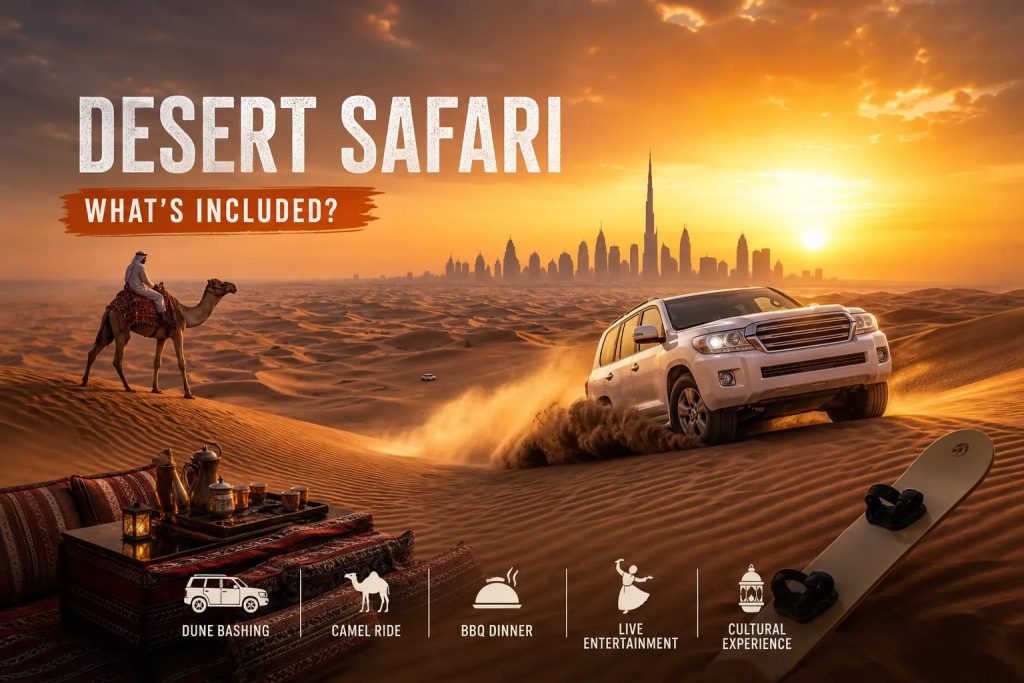
A standard Dubai desert safari package includes dune bashing, a camel ride, sandboarding, a BBQ dinner, cultural performances (Tanoura, belly dance, fire show), and hotel pickup. Add-ons like quad biking and falcon photos cost extra and are paid at camp. VIP and private tiers upgrade the comfort and exclusivity of the experience, not the core activities themselves.
The decision framework is straightforward: if you want the complete experience without surprises, choose an operator who bundles everything upfront with clear, transparent pricing. Read the inclusions list before you pay, not after. Ask the four questions above, and you’ll avoid the confusion that catches most first-timers off guard.
Desert Leap Safari is built to make this exactly as simple as it should be. Their package includes everything outlined in this guide, dune bashing, camel rides, BBQ dinner, cultural entertainment, and free hotel pickup, all in one booking, with no hidden charges at camp. Get in touch with the team or book directly online to confirm availability for your travel dates.